

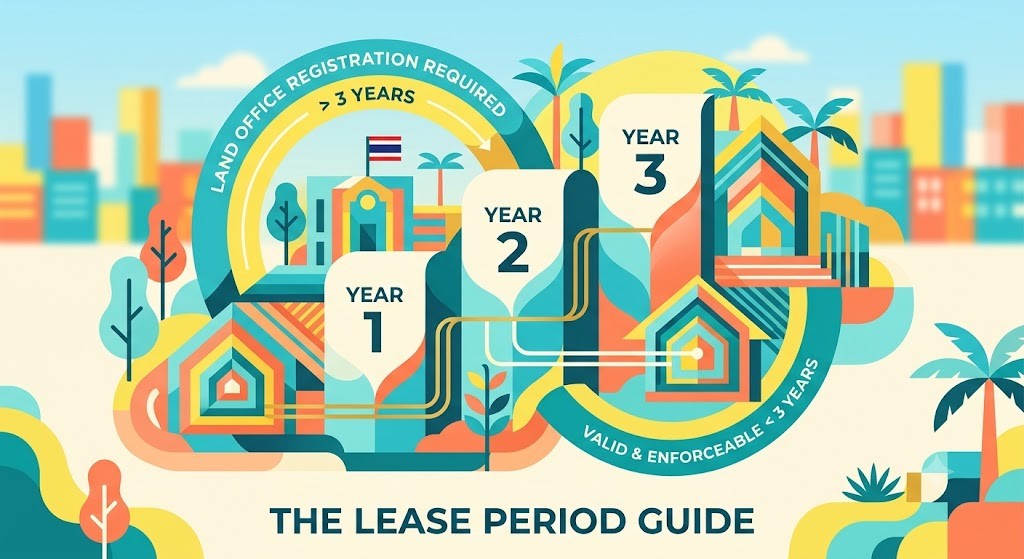
The main reason you often see lease contracts written for not more than 3 years (sometimes exactly 3 years) is because of legal enforceability and registration rules under Thai law as follows:
1. Enforceability without registration
• A lease up to 3 years does not need to be registered with the Land Department. It’s valid and enforceable in writing between landlord and tenant.
• A lease over 3 years must be registered at the Land Office to be legally enforceable for the full period.
2. Practical issues with registration
• Registering requires the landlord to go to the Land Department, pay fees, and have the lease officially recorded on the title deed. Many landlords prefer to avoid this process.
• Without registration, any lease longer than 3 years is only enforceable for up to 3 years, even if the agreement says 5, 10, or 30 years.
3. Flexibility and common practice
• Most landlords and tenants prefer a 1- 3 years contract with options to renew, because it avoids government registration while still providing enough security.
• Large or long-term projects (like commercial leases or resort land leases) sometimes do register for 10, 20, or 30 years, but this is less common for residential rentals.
✅ In short:
Residential leases are usually capped at 3 years because anything longer requires an official registration process at the Land Office. Keeping it at 3 years or less keeps the process simple, fast, and legally secure for both parties.